
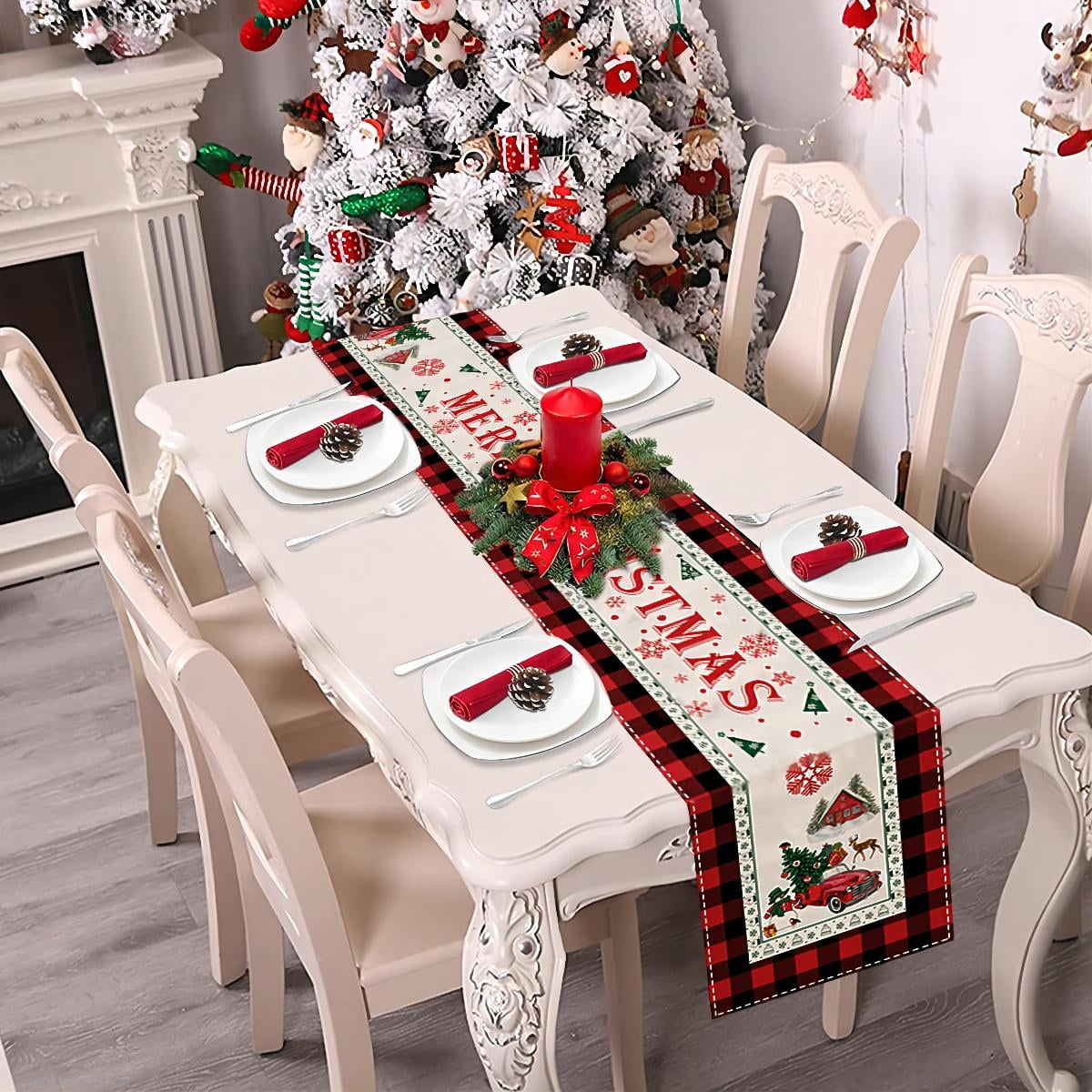
The scent of pine needles, the soft clink of crystal glasses, and a richly embroidered runner stretching the length of the banquet table—this tableau feels inevitable every December. Yet most of us never pause to wonder why the runner looks the way it does, or how a pattern that first appeared on a 17th‑century Dutch merchant’s table ended up stitched onto a mass‑produced linen in a suburban home.
Picture a snow‑laden manor house in 1845, the great hall lit by oil lamps, servants laying a hand‑woven silk runner that bears a pine‑cone lattice and a single gold‑threaded star. The runner is more than décor; it is a silent proclamation of wealth, faith, and seasonal ritual. Fast forward to a sleek, minimalist loft in 2026 where a reclaimed cotton runner, dyed with vegetable pigments, anchors a sustainable holiday spread. The visual language is recognizably “Christmas,” but the lineage is anything but obvious.
Understanding that lineage gives you the power to choose a runner that resonates—whether you crave historic authenticity, a story‑rich heirloom, or an eco‑forward statement. The following guide untangles the threads of tradition, decodes the symbolism, and hands you a practical roadmap to design a runner that feels both timeless and personal.
The journey begins in the bustling markets of medieval Flanders, where merchants displayed their wares on cloths that doubled as advertising banners. Those early “table linens” were functional yet carried bold, repeating motifs—stylized holly, geometric stars, and the occasional heraldic shield. As the Renaissance blossomed, the burgeoning middle class demanded decorative objects that signaled both piety and prosperity. Table runners emerged as a distinct format: a narrow, elongated fabric that could be draped over a long banquet table without overwhelming the dishes.
By the Victorian era, the runner had become a canvas for elaborate narrative scenes: angels bearing gifts, snowy villages, and the Nativity rendered in painstaking silk embroidery. The Industrial Revolution introduced mechanised Jacquard looms, allowing intricate patterns once reserved for aristocratic courts to be reproduced at scale. Yet even as machine production surged, a counter‑current of hand‑crafted runners persisted in rural workshops, preserving techniques like bobbin lace edging and natural dyeing that modern makers still revere.
Today, the runner sits at the intersection of heritage and innovation. Artisans on platforms like Etsy and Instagram blend antique patterns with reclaimed fabrics, while large retailers push synthetic blends marketed as “easy‑care holiday décor.” The tension between authenticity and convenience fuels a vibrant niche market: collectors, designers, and DIY enthusiasts who crave depth behind the decorative strip that runs beneath their Christmas feast.
Origins of the Holiday Table Runner: From Medieval Banquets to Victorian Parlors
The earliest recognizable table runners appear in 14th‑century Italian inventories, described as “stracciata di lino”—a narrow linen strip used to protect expensive wooden tables from wine spills. These pieces were plain, often left unhemmed, because their primary function was utilitarian. Yet even in these modest beginnings, the runner’s shape hinted at a future symbolic role: a linear element that could “lead the eye” from one end of the banquet to the other, framing the communal feast.
In the Low Countries, the rise of the merchant class introduced a new visual language. Cotton and silk imports from the Ottoman Empire arrived in Antwerp, bearing intricate arabesques and stylised flora. Merchants commissioned runners that displayed their trade logos—often a pine tree or a stylised “Y” for “Ypres.” Surviving fragments show a penchant for repetitive motifs, a precursor to the modern “Christmas pattern” of holly leaves and berries.
The Reformation injected theological meaning into textile design. Protestant households, wary of overtly Catholic iconography, favored botanical symbols—evergreen boughs, pine cones, and the star of Bethlehem rendered as a simple five‑pointed shape. These motifs could be embroidered with linen thread, a cheap yet durable choice, allowing even modest families to adopt a “Christ‑centered” aesthetic without breaking the bank.
The Victorian era, fueled by Queen Victoria’s own love of Christmas, transformed the runner into a storytelling device. Pattern books published by firms such as Morris & Co. featured runners with “Victorian Snowflake” motifs—interlocking hexagons filled with tiny silk beads. The introduction of the Jacquard loom in the 1820s meant that a single run of cloth could embed these detailed designs directly into the weave, eliminating the need for after‑the‑fact embroidery.
Meanwhile, the Arts and Crafts movement championed a return to hand‑woven textiles. William Morris’s guild produced runners in “tussar silk” with natural indigo and madder dyes, emphasizing the moral value of handcrafted work. These pieces carried a subtle anti‑industrial message, a sentiment that resurfaces in today’s maker culture.
Understanding these epochs—medieval utility, mercantile branding, Reformation symbolism, Victorian narrative, and Arts‑and‑Crafts authenticity—provides a roadmap for decoding any runner you encounter. The next step is to read the visual code embedded in the motifs and colours.
Symbolism Woven In: Motifs, Colors, and Their Meanings
A classic Christmas runner is a visual shorthand, each element chosen for cultural resonance. The evergreen pine, for example, originates from medieval Germany where pine branches were hung in churches to symbolize eternal life. When woven into a runner, the needle‑pointed silhouettes convey resilience and continuity—qualities families sought to project during the darkest weeks of winter.
The star motif underwent a dramatic evolution. Early Renaissance runners featured a “Magen David”‑like six‑pointed star, a generic decorative element. By the 16th century, the five‑pointed star—representing the Star of Bethlehem—became standard, often rendered in metallic gold thread to catch candlelight. The shift mirrors the Protestant emphasis on biblical narratives over saintly iconography.
Berries, whether holly or mistletoe, carry a dual symbolism. Holly’s red berries were associated with the blood of Christ, while mistletoe’s white berries signified purity. In 19th‑century England, a runner patterned with alternating holly and mistletoe signaled both religious reverence and the secular celebration of courtship—mistletoe being the traditional kissing plant.
Colour palettes also tell a story. Deep crimson dye, derived from cochineal insects, entered European textiles in the 1500s and instantly became a status marker, as the extraction process was labor‑intensive. A runner with a rich scarlet background signified wealth. Conversely, the muted greens produced from woad or later from synthetic aniline dyes (post‑1856) indicated accessibility for the burgeoning middle class.
When modern designers recycle historic motifs, they often blend these traditional meanings with contemporary concerns. A runner featuring a pine‑cone lattice rendered in reclaimed denim blue may nod to sustainability while still invoking the notion of endurance. Recognising the symbolism allows you to either honor the original narrative or subvert it deliberately—both powerful design choices.
Crafting the Classic: Materials, Techniques, and Regional Variations
The tactile quality of a runner hinges on its fibre composition. Linen, prized for its high tensile strength (≈ 5 cN/tex), resists wear and absorbs spills without staining—a practical reason for its dominance in early European tablescapes. Cotton damask, introduced in the 17th century, offers a glossy sheen due to its satin weave, making it popular among English gentry.
Silk faille, with its ribbed texture, became the hallmark of elite Victorian runners. Its rib count—typically 12–14 ribs per inch—creates a subtle three‑dimensional effect that catches candlelight, enhancing the festive ambience. Modern recreations sometimes substitute silk with Tencel™ Lyocell, a wood‑pulp fibre that mimics silk’s drape while scoring a lower environmental impact (production water use < 10 L/kg versus silk’s 2,500 L/kg).
Weaving techniques vary by region. The Dutch “broadcloth” method produces a dense, smooth fabric ideal for detailed Jacquard patterns; the Scottish “tartan runner” incorporates wool warp with cotton weft, resulting in a tactile contrast cherished in Highland homes. In Japan, the “kasuri” technique—pre‑dying warp and weft before weaving—creates a blurred, ethereal motif reminiscent of snow‑covered landscapes, a subtle nod to the season’s quietude.
Embroidery remains a finishing flourish. Bobbin lace edging, once a cottage‑industry staple in 19th‑century France, adds a lace‑like fringe that softens the runner’s edges. Contemporary makers often employ machine‑stitched “puff embroidery” using polyester thread, which provides a three‑dimensional raised effect without the labor intensity of hand‑sewing.
When sourcing materials, note the thread count and weight. A classic runner for a standard 8‑foot banquet table typically measures 12–14 inches in width and 90–100 inches in length. A fabric weight of 180–220 gsm (grams per square metre) balances heft and drape, preventing the runner from sliding while allowing it to fold neatly when not in use.
Step‑by‑Step Practical Implementation Guide
Step 1 (Define the Narrative): Choose a central motif—pine cone lattice, five‑pointed star, or a custom family crest. Sketch the pattern at a 1:10 scale on graph paper; this ensures repeatability when transferring to a loom or embroidery hoop.
Step 2 (Select Fibre and Dye): Opt for a base fabric that matches your desired weight and sustainability goals. For an heirloom feel, source 100 % organic linen with a 190 gsm weight. If you prefer a low‑maintenance option, choose a Tencel‑cotton blend (70 % Tencel, 30 % cotton) pre‑treated with a natural, low‑pH mordant to lock in vegetable dyes.
Step 3 (Prepare the Loom or Embroidery Frame): For woven runners, set up a drawloom or a modern electronic Jacquard with a warp density of 30 ends per inch. If you’re hand‑embroidering, tension the fabric in a 6‑inch embroidery hoop, ensuring the surface remains taut to avoid puckering.
Step 4 (Execute the Motif):
Weaving: Load the pattern punch cards (or digital file) into the Jacquard controller; run a test swatch of 12 inches to verify colour fidelity and pattern alignment.
Embroidery: Use a 5‑mm embroidery needle and a 100 wt cotton thread for fine outlines; switch to 40 wt silk thread for accent stitches such as seed‑fill or bullion knots.
Step 5 (Finishing Touches): Trim excess edges with a rotary cutter, then hem the runner using a ¼‑inch blind stitch to conceal raw edges. Apply a light starch spray (10 % wheat‑starch solution) and press with a low‑heat iron (max 120 °C) to set the drape. Finally, store the runner rolled around a 3‑inch PVC pipe to prevent creasing until the holiday season.
Following this workflow yields a runner that not only looks authentic but also stands up to the rigors of a family feast—spills, heat from serving dishes, and the occasional enthusiastic pet.
Common Pitfalls & Field‑Tested Workarounds
Pitfall 1 (Mismatched Thread Count): Selecting a fabric with too low a thread count (under 200 tpi) leads to a flimsy runner that frays after a few washes. Workaround: Source fabric from reputable mills that certify a minimum of 250 tpi for linen or 300 tpi for cotton damask; request a sample swatch before committing to bulk.
Pitfall 2 (Improper Dye Fixation): Natural dyes like indigo can bleed when exposed to moisture, especially on a runner that will host gravy boats. Workaround: After dyeing, treat the fabric with a post‑dye copper‑sulfate fixative (2 g per litre of water) and cure for 24 hours at 60 °C. Conduct a wash test on a hidden seam before full‑scale application.
Pitfall 3 (Over‑Complicated Motifs): Over‑intricate patterns may lose definition on a narrow strip, appearing as a visual blur. Workaround: Limit the motif repeat to every 12 inches and keep individual elements under ½ inch in size. Use a high‑resolution mock‑up to preview the effect before weaving.
Pitfall 4 (Improper Hemming): A loose hem invites snagging and fraying, especially when the runner is pulled across a polished table. Workaround: Use a blind stitch with a ¼‑inch seam allowance, reinforcing the hem with a lightweight fusible interfacing (0.3 mm) to add durability without adding bulk.
Pitfall 5 (Neglecting Seasonal Wear): Many creators assume a runner will be stored unused after the holidays, but improper storage leads to creases and mildew. Workaway: Roll the runner around a breathable cotton tube, store in a climate‑controlled closet (relative humidity 45–55 %), and add a lavender sachet to deter mold.
Holistic Perspectives & Long‑Term Impact
The resurgence of classic Christmas runners dovetails with a broader consumer shift toward “story‑rich” home goods. Market data from Euromonitor (2025) shows a 27 % year‑on‑year increase in sales of heritage‑styled textiles, driven largely by millennials who value provenance over pure aesthetics.
Sustainability amplifies this trend. A lifecycle analysis by the Textile Exchange (2024) indicates that reclaimed cotton runners have a carbon footprint 45 % lower than newly produced polyester‑blended runners. Moreover, the use of natural dyes cuts water pollution by up to 60 % compared with conventional azo‑based dyes. Designers who foreground these metrics can command premium pricing—average retail price for a handcrafted, upcycled runner in 2026 hovers around $120, versus $45 for a mass‑produced synthetic counterpart.
Technological advances also reshape the field. Generative AI‑assisted design platforms now allow artisans to input historic pattern files and receive a vector‑ready file optimized for CNC‑embroidered runners. While some purists balk at digital intervention, the ability to replicate a 17th‑century Dutch motif with millimetre precision opens new possibilities for limited‑edition collections.
Finally, the cultural relevance of the runner extends beyond décor. In many diaspora communities, a runner passed down through generations serves as a tangible link to ancestral customs, reinforcing identity during the holiday season. Community workshops that teach traditional weaving techniques not only preserve craft knowledge but also foster intergenerational bonding—a social benefit that transcends the fabric’s material value.
Actionable Recommendations & Key Takeaways
Prioritise Material Integrity: Choose fibres with a proven track record for durability (linen, high‑gsm cotton, or responsibly sourced silk). Verify thread count and weight before purchase.
Embrace Authentic Colour Palettes: When aiming for historic accuracy, replicate period‑specific dyes—cochineal reds, indigo blues, and madder oranges—using modern low‑impact mordants.
Balance Complexity and Scale: Limit motif size to under ½ inch and repeat intervals to 12‑inch increments for visual clarity on a narrow runner.
Invest in Proper Finishing: Blind‑stitched hems, light starching, and low‑heat pressing extend the runner’s lifespan and maintain a crisp appearance.
Plan for Sustainable Storage: Roll, not fold; use breathable tubes; control humidity to prevent mildew.
Leverage Technology Thoughtfully: Utilize digital pattern libraries for precision, but retain hand‑finished touches (e.g., bobbin lace edging) to preserve the tactile authenticity that defines a classic runner.
By internalising these guidelines, you can move from passive consumer to informed creator—selecting, customizing, or even fabricating a table runner that tells a story as rich as the holiday meals it frames.
The humble runner, stretched across centuries, has evolved from a functional strip of cloth into a cultural artifact that encapsulates faith, status, and craftsmanship. Its motifs whisper of medieval guilds, Reformation iconoclasm, Victorian exuberance, and today’s sustainability movement. Recognising this lineage transforms a simple decorative element into a conduit for personal and collective memory.
As we look forward, the table runner will likely become a hybrid of tradition and technology—a canvas for augmented‑reality overlays that narrate the provenance of each stitch, while the fabric itself remains rooted in tactile, hand‑crafted authenticity. Makers who honor the past while embracing eco‑conscious materials and digital tools will shape the next chapter of this enduring holiday tradition.
Your holiday table awaits. Whether you unroll a reclaimed linen runner dyed with wildflower extracts or commission a bespoke silk piece echoing a 19th‑century pattern, you are participating in a dialogue that spans generations. The next time you set the table, pause for a moment—feel the weight of the fabric, trace the embroidered pine cone, and let the hidden history enrich the celebration.
May your gatherings be warm, your stories vibrant, and your runner a testament to the timeless art of weaving meaning into the fabric of our lives.


