
You turn off the bedside lamp, pull up the weighted duvet, and close your eyes. Yet, hours later, you find yourself staring at the ceiling, counting the faint shadows cast by an erratic streetlamp. You have already swapped out your synthetic pillows for organic buckwheat hulls, installed blackout shades that plunge the room into absolute midnight, and cut off blue-light exposure two hours before bedtime. Still, sleep remains elusive, shallow, and frustratingly fragile.
The missing link is rarely found in your nighttime routine or your mattress firmness rating. Instead, the invisible barrier to deep, restorative sleep often sits right in your peripheral vision: the chaotic assembly of mismatched nightstands, conflicting wood grains, competing hardware finishes, and chaotic geometry that makes up your bedroom’s layout. When your eyes are closed, your brain is resting, but your subconscious visual processing centers never truly clock out.
For decades, the design world has wrestled with a polarizing debate. Trendy aesthetics champion the eclectic, high-contrast look of collected-over-time interiors. However, residential interior architects and sleep environment specialists frequently take a different stance. They quietly advocate for the psychological and neurological benefits of matching bedroom furniture sets. Far from being a relic of cookie-cutter furniture showrooms, a unified suite of furniture actively alters the cognitive load of a room. It transforms an over-stimulating environment into a sanctuary calibrated for profound biological rest.
The Neurological Architecture of Visual Calm and Sleep Onset
To understand why a matching bedroom furniture set supports better sleep quality, you have to look at how the human brain processes visual environments during the wind-down window. Evolutionary biology hardwired the human visual cortex to scan spaces for anomalies, threat vectors, and disorder. When you walk into a bedroom filled with mismatched pieces—a mid-century walnut dresser, a distressed white-washed pine nightstand, and a sleek black metal bed frame—your visual cortex must work overtime. It tracks disparate lines, clashing undertones, uneven scale, and jarring hardware styles.
Even with the lights extinguished, your brain retains a spatial map of that chaos. The neurological friction generated by visual asymmetry keeps the sympathetic nervous system on mild alert. It prevents the body from making a smooth, unhindered descent into Stage 3 slow-wave sleep and REM cycles. Interior designers refer to this phenomenon as visual noise. When you eliminate visual noise through a unified design strategy, you remove tiny, micro-distractions from your field of view.
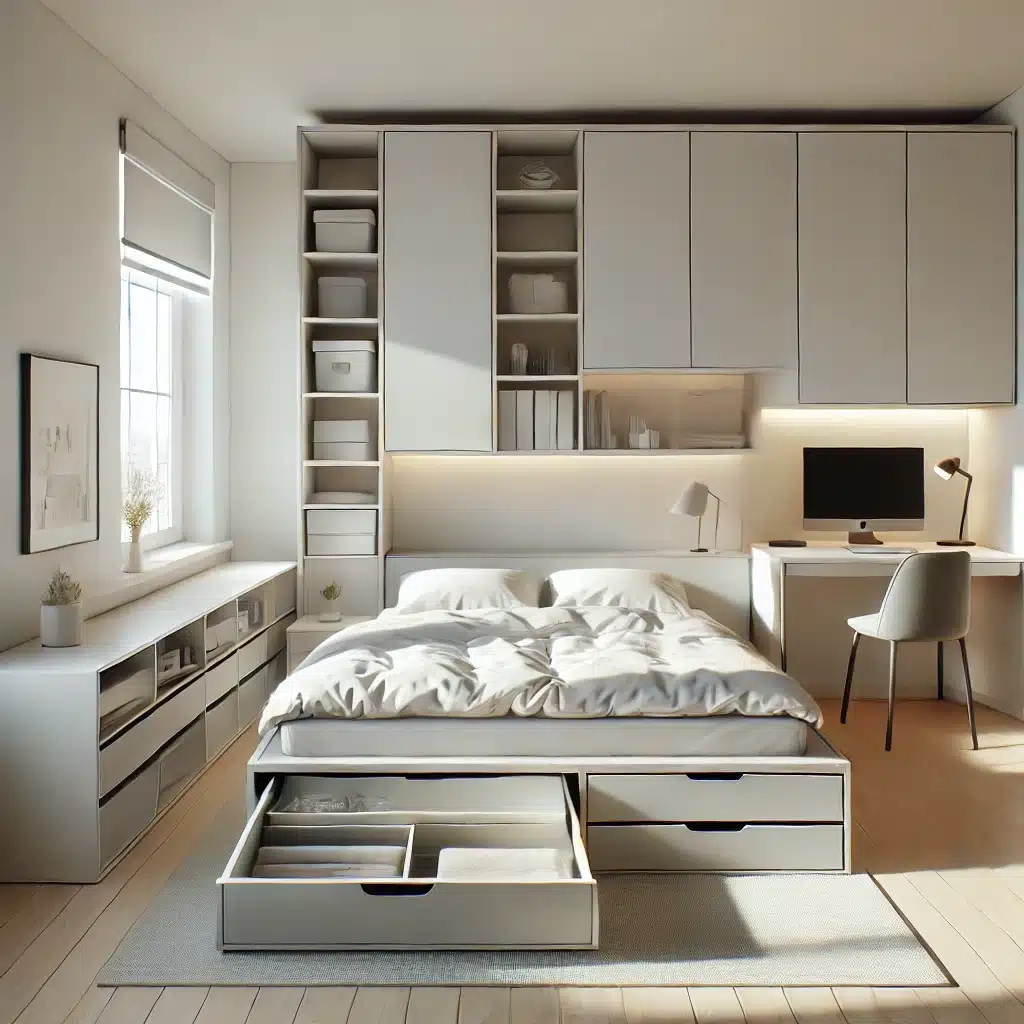
A matching bedroom furniture suite creates absolute visual rhythm. When the bed frame, nightstands, and dresser share identical wood species, matching grain directions, uniform hardware, and cohesive proportions, the brain registers the environment as orderly and safe. This uniformity reduces cognitive load. Without jarring visual interruptions, your nervous system can downshift from active processing to parasympathetic dominance much faster. This accelerates sleep latency—the time it takes you to fall asleep—and deepens overall sleep architecture.
Geometry, Scale, and Spatial Flow in Restorative Room Layouts
Sleep quality is deeply intertwined with spatial ergonomics. If your nightstands are too tall for your mattress, or your dresser juts too far into the primary pathway, your body experiences subtle, subconscious physical tension every time you navigate the room. Matching bedroom furniture sets solve this mechanical problem at the design stage. Manufacturers engineer these suites with precise dimensional harmony, ensuring that the bed height, nightstand surface plane, and storage units maintain balanced proportions relative to one another.
When furniture pieces are designed together, their footprints scale proportionally to standard bedroom dimensions. This geometric balance optimizes traffic flow and eliminates awkward pinch points. You stop bumping your shins on a protruding corner in the dark. Your phone, glass of water, and reading lamp sit at an exact, ergonomic height relative to your mattress top. This removes micro-movements and physical stretches that disrupt the sleep cycle.
Furthermore, consistent spatial geometry enhances the breathing room of a bedroom. A matched set establishes a predictable rhythm around the perimeter of the room. This visual breathing room tricks the brain into perceiving the space as larger, airier, and more secure. Claustrophobia and spatial congestion are known triggers for nocturnal anxiety. By anchoring the room with uniform furniture geometry, you create an open, breathable layout that encourages deep, diaphragmatic breathing once your head hits the pillow.
Step-by-Step Implementation for Curating and Positioning a Sleep-Optimized Suite
Investing in a matching bedroom furniture set is only half the battle. How you position, style, and integrate that suite into your actual bedroom architecture dictates its ultimate impact on your sleep hygiene. Moving from a chaotic layout to a sleep-sanctified space requires a methodical approach that balances aesthetic cohesion with circadian biology.
- Step 1 (Audit Your Current Visual Noise): Strip the bedroom down to bare essentials. Remove all stray accent tables, random storage bins, and clashing accessories that do not serve an immediate sleep or functional purpose. Measure the exact square footage and architectural focal points, noting window and door placements relative to where your head will rest.
- Step 2 (Select a Cohesive Wood Tone or Finish): Choose a matching furniture set finished in low-VOC, non-toxic materials. Opt for warm, neutral wood tones like white oak, walnut, or soft maple with matte finishes. Avoid high-gloss lacquers or reflective metallic laminates that bounce stray light from streetlamps or early morning sun directly into your eyes.
- Step 3 (Position the Core Anchor Pieces): Place the bed frame on the command wall—the wall furthest from the door with a clear line of sight to the entryway, but out of the direct path of drafty windows. Flank the bed with the matching nightstands, ensuring the tabletop sits level with or slightly above the top of your mattress for seamless nighttime access.
- Step 4 (Calibrate Lighting and Hardware Integration): Install matching low-color-temperature (2200K to 2700K) lamps on your nightstands. Ensure the hardware on your matching dressers and nightstands features brushed or matte finishes (like brushed brass or oil-rubbed bronze) that absorb ambient light rather than creating harsh glares.
- Step 5 (Soften the Uniformity with Textures): Prevent the matching set from feeling clinical or sterile by introducing tactile, organic textiles. Layer heavy Belgian flax linen bedding, a heavy wool or chunky knit throw, and an unbleached wool area rug beneath the bed to absorb sound and cushion your first steps upon waking.
Navigating Common Design Pitfalls and Preserving Personal Sanctuary
A frequent critique of matching bedroom furniture sets is that they can inadvertently make a room feel stiff, sterile, or reminiscent of a generic hotel room. While visual uniformity promotes sleep, absolute monotony can starve the room of personality, making it feel unwelcoming. The key is knowing how to leverage the calming foundation of a matching set while introducing subtle, humanizing layers that don’t trigger visual anxiety.
- Pitfall 1 (The Sterile Showroom Trap): Buying an entire 7-piece suite—bed, two nightstands, dresser, chest of drawers, media console, and mirror—and cramming it all into a modest room creates visual congestion. Workaround: Purchase only the core triad essential for sleep—the bed frame and two nightstands—from a matching collection, or space out secondary pieces along different walls to avoid a monolithic wall of wood.
- Pitfall 2 (Ignoring Surface Clutter on Matching Units): Having a gorgeous matching dresser is useless if it becomes a staging ground for mail, laundry piles, and tech gadgets. Workaround: Treat matching surfaces as sacred, blank zones. Keep nightstands clear of everything except a lamp, a book, and a glass of water to maintain the neurological calm provided by the set.
- Pitfall 3 (Harsh Lighting Destroying the Finish Harmony): Putting high-lumen, cool-white bulbs overhead washes out the subtle wood grains and undertones of a matching set, creating an institutional vibe. Workaround: Ditch the overhead ceiling light entirely in favor of dimmable bedside sconces or table lamps that cast warm, downward pools of light.
- Pitfall 4 (Neglecting Sound and Air Acoustics): Even with matching furniture, hard reflective surfaces can bounce sound waves around, amplifying minor nocturnal noises that wake you up. Workaround: Use the visual stability of your matching furniture to anchor soft acoustic absorbers, such as heavy velvet drapery or upholstered wall panels behind the bed.
- Pitfall 5 (Sourcing Low-Quality Materials Off-Gas): Many budget-friendly matching sets are constructed from particleboard bonded with formaldehyde-heavy glues that off-gas toxic volatile organic compounds throughout the night. Workaround: Invest in solid wood or Greenguard Gold certified matching sets that protect both your visual peace and your indoor air quality.
The Broader Impact of Material Honesty and Circadian Alignment on Well-Being
Creating a sleep-centric bedroom goes beyond immediate aesthetic preferences. It touches on environmental psychology and material health. When you select a high-quality matching bedroom set crafted from sustainable, solid hardwoods—such as sustainably harvested ash, cherry, or white oak—you invite the natural world indoors. Biophilic design principles show that exposure to authentic wood grain patterns and natural textures reduces cortisol levels, lowers resting heart rates, and stabilizes blood pressure.
When these natural elements are repeated harmoniously across multiple furniture pieces, the biophilic effect amplifies. Your bedroom ceases to be a storage locker for disparate items and becomes a cohesive micro-ecosystem. This environmental stability supports your circadian rhythm. Modern life bombards our nervous systems with erratic inputs from screens, artificial lighting, and urban noise. A bedroom furnished with deliberate, calming unity acts as a biological fortress. It signals to your endocrine system that the day is over, facilitating the natural melatonin surge required for restorative sleep.
Furthermore, purchasing a cohesive, well-built furniture set aligns with sustainable consumer habits. Instead of continuously cycling through cheap, mismatched pieces that break down or fall out of style, investing in a timeless, high-integrity matching suite reduces consumption cycles. It anchors your home in enduring craftsmanship, ensuring that your sleep sanctuary remains a peaceful, low-maintenance retreat for decades.
Strategic Recommendations for Transforming Your Sleep Environment
To put these insights into practice, approach your bedroom redesign through the lens of sensory reduction and spatial harmony. Start by evaluating your current sleep friction points. Are you waking up with unexplained neck tension from poor nightstand heights? Is your mind racing as you scan a cluttered room of clashing styles before turning out the lights?
Begin your transformation by prioritizing the core sleep zone. Invest in a solid, matching bed frame and nightstand pairing that speaks to a calming, natural aesthetic. Keep hardware minimalist, finishes matte, and lines clean. Surround this core suite with organic, tactile textiles that absorb sound and soften the room’s acoustics. Keep decorative accents minimal, purposeful, and free of screens or high-contrast patterns.
By treating your bedroom furniture as an integrated ecosystem designed for neurological calm rather than a random collection of trendy statement pieces, you reclaim the true purpose of the room: deep, uninterrupted, biological restoration.
The pursuit of better sleep is an ongoing dialogue between our biological needs and our built environments. We spend roughly a third of our lives resting in the bedroom, yet we often subject this sacred space to the same design chaos as our home offices or living rooms. We load it with visual static, conflicting geometries, and material clutter, wondering why our bodies refuse to fully relax.
Opting for a matching bedroom furniture set is not an admission of design defeat or a surrender to boring convention. It is an intentional choice to prioritize nervous system calm over fleeting interior trends. By establishing visual rhythm, spatial harmony, and material honesty, you clear the path for your body to do what it was designed to do: rest deeply, recover completely, and wake up restored.


