
The TV console arrived on a Tuesday, flat-packed in a box the size of a coffin. By Sunday, the shelf was already bowing under the weight of three hardcover books and a ceramic vase. Eighteen months later, the peel-and-stick veneer curled at the corners like a sunburned tourist, and the particleboard underneath had swollen into that ugly, grainy puffiness that happens when someone sets a sweating glass down without a coaster. You know the look. You’ve probably lived with it.
Now picture the opposite: a six-foot walnut media console with dovetailed drawers, hand-oiled surfaces, and that deep, chocolatey depth you can only get from a tree that spent forty years pulling nutrients out of the soil. Twenty years from now, that console will still be standing. It will have a few dents, maybe a ring or two that didn’t quite get wiped in time. But instead of looking worse, it will look better—richer, warmer, more alive. That’s the quiet magic of solid wood. It doesn’t just age; it matures.
The way a room ages has very little to do with wallpaper or throw pillows, and almost everything to do with the bones. Your sofa will sag. Your rug will fade. Your paint will need touching up. But the sideboard, the bookcase, the coffee table—those are the pieces that either become part of your home’s story or become cautionary tales on the curb waiting for bulk pickup day. The choice is deliberate, and it starts with understanding what you’re actually buying.
The Honest History of Furniture That Was Built to Outlast Its Owners
Furniture wasn’t always disposable. Up until the mid-twentieth century, the average middle-class home in Europe and North America contained very few pieces, and nearly all of them were made from solid wood. A dresser in 1900 wasn’t expected to survive a decade—it was expected to survive a marriage, a mortgage, and a migration across the prairie. Cabinetmakers used quarter-sawn white oak, maple, and walnut, joined with mortise-and-tenon or dovetail joints, and finished them with shellac, lacquer, or boiled linseed oil. These pieces were repaired, not replaced. When a drawer stuck, you waxed the runners. When a leg wobbled, you shimmed it. The furniture was a fixture, as permanent as the plumbing.
The shift began in the 1950s with the rise of cheap plywood, and accelerated dramatically in the 1990s with the flood of "flat-pack" furniture from Scandinavian and, later, global retailers. The math was simple: charge less, use less material, and treat furniture as a consumable product, not a durable investment. Category killers like "MDF" (medium-density fiberboard) and "particleboard" became household terms—if not household favorites. The average lifespan of budget furniture today? Roughly five to eight years, depending on how often you move, how heavy your children are, and whether your home’s humidity swings in double-digit swings.
Here’s the irony: in 2026, as housing prices climb and people stay in homes longer, the disposability mindset is dying. Designers and homeowners are gravitating back to solid wood because it solves real problems: durability, repairability, patina, and permanence. It’s not nostalgia. It’s math. As we’ll unpack, a solid wood table that costs $1,800 today and lasts forty years costs $45 per year. A $300 particleboard table that collapses in four years costs $75 per year—and looks terrible the whole time.
Solid Wood vs. Everything Else: What You’re Actually Paying For
Let’s get precise about what "solid wood" means, because the furniture industry uses the term the way a casino uses "complimentary." A genuinely solid piece isn’t made from a single slab of tree. It’s made from real, milled lumber throughout—top, sides, legs, drawer fronts, and drawer boxes. No veneer over substrate. No MDF core with a wood-facsimile wrap. When you knock on a solid wood panel, it sounds like knocking on a solid door. When you knock on veneered MDF, you get a thinner, almost plasticky rap. That difference isn’t just acoustic. It’s physical.
The Species Lineup (and What Each Brings to the Party)
- White Oak: The heavyweight champion of living room furniture. Dense, strikingly grained, naturally water-resistant thanks to its closed cellular structure. A Janka hardness rating around 1,360 lbf means it shrugs off impact. It ages to a warm, honeyed amber when finished with oil.
- Black Walnut: The refined choice. Darker, luxurious, almost chocolate-brown, with a grain that’s straight and elegant. Janka rating around 1,010 lbf—slightly softer than oak, but still plenty sturdy for a console or coffee table. Requires more protection from dings, but blends beautifully with almost any palette.
- Cherry: The chameleon. Cherry starts as a pale, pinkish board and darkens dramatically with UV exposure, deepening into a rich, reddish-brown over 12–24 months. If you want furniture that announces its age with gratitude, cherry is unmatched. Janka: 950 lbf.
- Maple: Pale, clean, and nearly invisible grain. Ideal for modern, minimalist spaces because it recedes and lets other elements speak. Janka: 1,450 lbf. Very hard, but can be visually flat.
- Pine: The charming budget option. Soft (Janka: 380–540 lbf depending on species), prone to dents, but full of knots and character. Perfect for a farmhouse aesthetic or a kids’ playroom where scuffs are badges of honor. Just know that pine will show every moment you’ve lived.
- Teak: The exotic survivor. Extremely high natural oil content makes it resistant to moisture, insects, and rot. Teak is the go-to for outdoor furniture, but its golden-brown warmth works surprisingly well indoors. Janka: 1,000–1,150 lbf.
Those Janka numbers aren’t marketing fluff. They’re standardized measurements of force, in pounds, required to embed a 0.444-inch steel ball halfway into the wood. It’s the closest thing furniture has to a crash test rating. When someone pushes a heavy brass lamp across your teak console without a felt pad, you’ll feel the difference between maple and pine in the channel it carves.
Wood Movement and the Myth of the Immovable Table
Solid wood is alive. It drinks moisture from humid summer air and exhales it in dry winter months, expanding and contracting across the width of each board. A 24-inch-wide oak tabletop can shift by as much as 3/16 of an inch between seasons. Quality builders account for this with floating panels, slotted screw holes, and breadboard ends. Cheap builders glue the wood down rigidly, and five years later, the tabletop splits right up the middle.
This is also why solid wood furniture is almost never finished with thick, plastic-like polyurethane on the top face. That would trap moisture and accelerate cracking. Professional furniture makers use hardwax oils, Danish oil, or a thin, penetrating lacquer—finishes that soak into the wood fibers, which allow the board to breathe while still protecting from spills. When you’re evaluating a piece, ask what finish was used. If the salesperson says "lacquer" and the price is under $800, it might be a spray-on shell over veneer. Read the fine print, and if possible, feel the grain with your fingertips. If you can’t feel texture at all, that’s often a sign the "wood" is actually printed paper laminated to substrate.
The Real Economics of Aging Gracefully: Cost Per Year, Resale, and Repair
Let’s talk dollars, because nobody pays $2,000 for a coffee table without flinching a little.
The lifecycle cost of solid wood furniture is dramatically lower than cheap alternatives across any meaningful timeframe. Here’s a back-of-the-envelope scenario:
You buy a mid-range solid oak entertainment console at $1,400. With ordinary care—dusting, occasional oiling, coasters for sweaty glasses—it lasts 30 to 40 years, easily. Two generations could pass it down. Cost per year of ownership: $35–$47.
You buy a $350 particleboard and veneer console from a big-box store. It starts sagging around year three, delaminates around year five, arrives stained and warped by year seven. You replace it. Over 35 years, you buy five of them. At a modest 4% inflation, your total expenditure: $1,750–$3,000, plus five trips to the dump and a nagging sense of aesthetic failure every single day you look at it. Cost per year: essentially double or triple.
The comparative math doesn’t stop at replacement cycles. Solid wood furniture carries genuine resale value. A well-maintained mid-century teak sideboard from the 1960s sells on the vintage market for three to ten times its original inflation-adjusted price. The same cannot be said for a 2016 IKEA Billy bookcase, which sells for approximately $10 at a yard sale. Premium brands—think Stickley, Room & Board, Thos. Moser—routinely sell used pieces for 60–80% of original retail after 20 years.
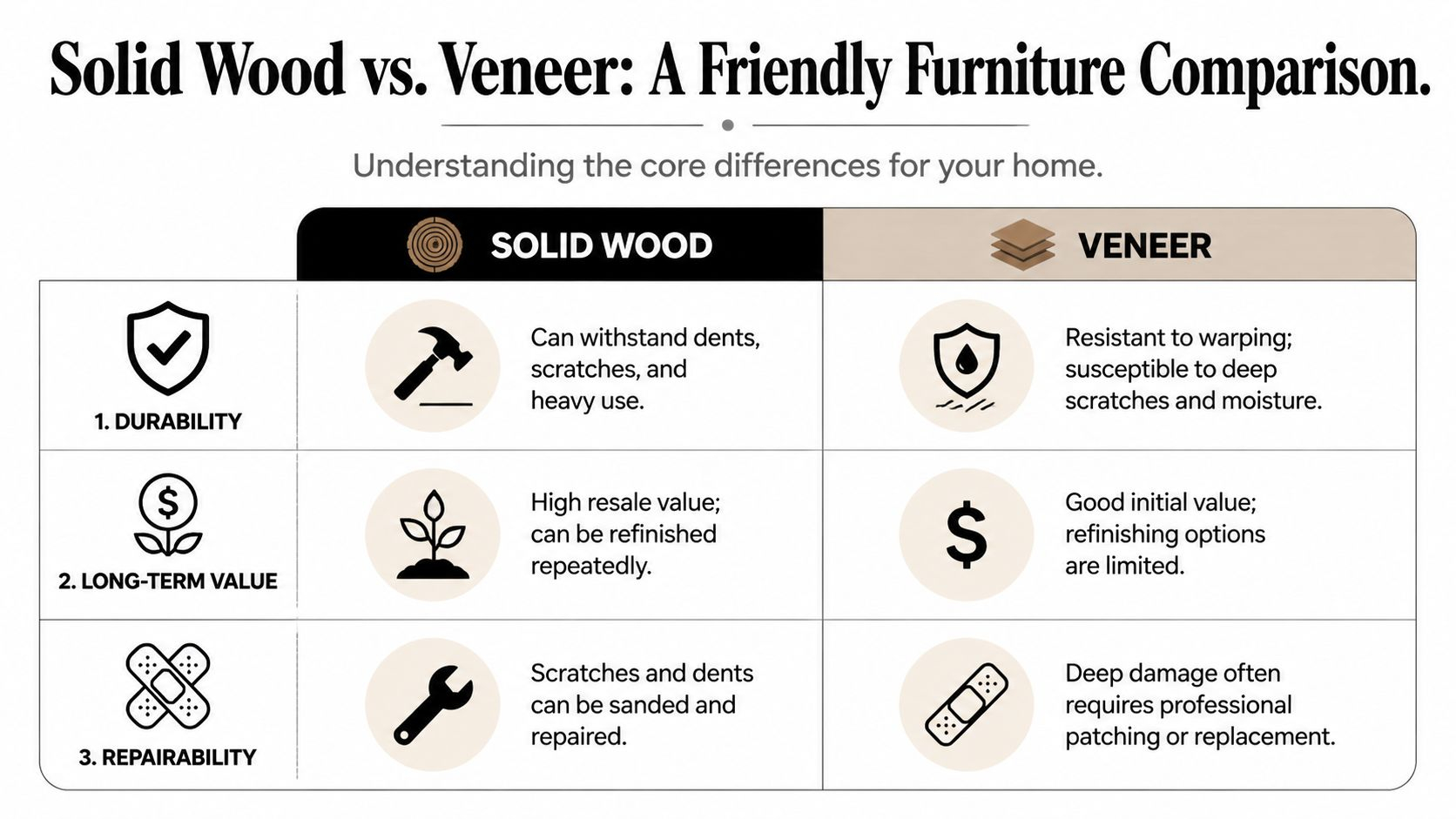
Repairability is the hidden multiplier. A solid wood armrest that gets gouged can be sanded, steamed, or filled and refinished to match perfectly. A veneered or particleboard armrest cannot. Once that surface is damaged, the damage is permanent and usually spreads. Solid wood scratches into the wood, which is a feature. Veneer scratches into death. Pawn shops and estate sales are full of 70-year-old solid wood furniture. They are categorically empty of 7-year-old MDF furniture.
How to Buy Solid Wood for Your Living Room: A Five-Step Field Manual
Buying solid wood isn’t complicated, but it does require a different mindset than buying fast furniture. You’re not shopping for a trend. You’re shopping for a 40-year relationship. Here’s how to structure that search, based on how professional furniture buyers and interior designers actually approach it.
Step 1 (Define Your Room’s Hard-Use Zones): Walk through your living room and note the surfaces that will physically endure the most abuse. Coffee table? Media console? Side tables? Bookshelves? These are the pieces that need high-Janka woods like oak, maple, or teak. A bedroom dresser can get away with cherry or pine because the traffic is gentler. But the coffee table in a house with kids and dogs is a combat zone. Spend your wood budget there first. It’s better to have one outstanding solid wood coffee table and one acceptable budget side table than two mediocre pieces with zero longevity.
Step 2 (Learn the Three Construction Red Flags That Indicate Faux Wood): Before you buy anything, check: (a) Does the drawer box use dovetail joins or butt joints? Dovetails, visible at the drawer’s corner, indicate craftsmanship. Butt joints stapled together mean it’s engineered for landfill proximity. (b) Is the drawer box itself solid wood? Many manufacturers put cheap veneered particleboard drawers inside a solid wood carcass to save $40. Open the drawer and smell it. Particleboard has a distinct, sharp formaldehyde odor. (c) Are the legs carved or glued? Solid legs turned from a single blank are strong. Legs with visible seams or plastic glides screwed into a hollow chamber are a giveaway of composite materials. If the joint where leg meets frame is hidden under a veneer cap, walk away.
Step 3 (Match Wood Species to Your Room’s Environment): If you live in a region with extreme seasonal humidity swings—think the American Midwest, the UK, or anywhere with wood-burning stoves that dry the air brutally—choose quarter-sawn oak or teak. Their tighter grain structure resists moisture shifts better than flat-sawn boards. If you live in a coastal climate with stable humidity, cherry or walnut shine beautifully. Also think about your windows and sunlight: walnut and cherry darken with UV exposure. If your console faces a west-facing window and you love the precise pale honey hue of new cherry, expect it to fully change within two years. That’s not a defect; it’s the wood continuing to live.
Step 4 (Demand the "Finish Story" in Writing): Quality solid wood pieces are finished in a way that makes them repairable. Ideal finishes: rubio monocoat, osmo polyx, walrus oil, or a matte conversion varnish—all penetrating or micro-film finishes that soak into the grain rather than sit on top like plastic. Avoid "lacquer over filler" or "painted wood" unless you’re buying a painted piece intentionally, because you’ll never be able to refinish it without stripping layers of pigment. Ask the retailer or maker for the finish name. If they can’t tell you, that’s a red flag. If they say "polyurethane," that’s acceptable for a dining table (needs the extra protection) but less ideal for a bookshelf where you’ll want the natural grain to evolve.
Step 5 (Calculate Your True Budget in Cost-Per-Year, Not Price-Tag): A common mistake is anchoring on the sticker price as "expensive." Shift your frame: set a target lifespan (25+ years) and divide the price by that number. A $2,000 solid walnut credenza at $80/year is a bargain compared to a $400 veneered credenza at $100/year over just four years. But here’s the nuance—if the $2,000 credenza isn’t your style, you won’t keep it for 25 years. Buy pieces you truly love, in a finish that makes your chest tight. The room-dominant wood furniture you tolerate because it was "a good investment" is exactly the piece that ends up on Craigslist for $300 in a purge, replaced by a $1,800 version of what you actually wanted.
The Five Most Common Ways People Sabotage Their Solid Wood Investment (And the Fixes)
Even knowledgeable buyers mess this up. Here’s where the field-tested advice diverges from the glossy blog content.
Pitfall 1 (Storing Firewood Next to the Fireplace): This one sounds absurd until you see it. When you stack firewood indoors, warm interior air slowly evaporates the moisture in those logs. Bifrost data shows that a single rack of firewood indoors can raise ambient relative humidity by up to 10–15% in a dry month. That’s enough to cause wood furniture to expand, crack, and—worse—develop mold spores in unvented areas. The fix: store outdoor firewood in a ventilated shed or under a tarp, not in your living room. If you must keep a few days’ worth by the hearth, you’re basically running a humidifier for your sofas and your solid wood. Bad chemistry.
Pitfall 2 (Using Silicone-Based Furniture Polish): The aerosol polish with "lemon scent" might make your coffee table glow for exactly four days. But most of those products contain silicone, which penetrates the wood and makes future refinishing impossible. When you choose to have the table professionally sanded in year fifteen, that silicone will create deep fish-eyes in the new finish, and the refinisher will charge double to remove it. The workaround is embarrassingly simple: use a barely damp cotton cloth for everyday dust, and apply a coat of hardwax oil twice a year to maintain the surface. That’s it. No polish, no spray, no 60-second shine.
Pitfall 3 (Placing Hot Cups Directly on the Surface): Solid wood is more resistant to heat than veneer, but it isn’t fire-resistant. A mug straight off a stove burns the finish and opens the grain to moisture intrusion. Use trivets. That isn’t a tip from your grandmother; it’s a material science fact. At 140°F (60°C), most furniture oils soften enough to leave permanent clouding. At 200°F (93°C), the wood cells compress and the damage is visible for decades. A $900 mahogany end table deserves a $4 coaster.
Pitfall 4 (Placing Solid Wood on Radiant-Floor Heating): If your living room has hydronic or electric radiant heating beneath the floor, the floor surface temperature can reach 85–90°F. That’s not terrible for the wood itself, but the rapid, constant thermal cycling—warm floor, cool room—can cause very solid legs to expand and contract at different rates than the tabletop, creating stress at the joinery. The fix: use furniture coasters or felt pads that create a small air gap between the floor and the leg, and avoid extremely low-profile pieces that lay the wood flat against the heated surface.
Pitfall 5 (Buying "Solid Wood White-Wash" Hand-Me-Down Restorations): This is a bit nuanced, but critical: if you buy a vintage solid wood piece that’s been coated with chalk paint, milk paint, or that ubiquitous "white-wash" look, inspect the piece first. Those finishes soak into open-pored woods and permanently alter the grain. You can’t getting it back to the natural shell. The workaround isn’t a workaround: if you want that painted look, buy it as an intentional aesthetic, not as a "cheat" to get solid wood at a discount. The painted piece will be near-impossible to return to long-term, natural patina. It’s a lifestyle choice, not a strategic investment.
Why Designers Are Quietly Going All-In on Wood (and the Heirloom Economy)
Walk through any serious interior designer’s portfolio from the last five years, and you’ll notice a pattern: the rooms that feel permanent, calm, and expensive have very little playful plastic and an unusual amount of solid timber. This isn’t a "farmhouse chic" revival. It’s a response to what we psychologists now call "screen fatigue" and designers call "a craving for groundedness." In a home loaded with glass, steel, and polymer, a single substantial solid wood piece acts as an anchor. It doesn’t shout; it steadies the whole composition.
There’s also a generational shift at play. Millennials and Gen Z are inheriting fewer heirlooms than previous generations—divorce rates, mobility, and downsizing scattered the family furniture. In response, a surprising movement is emerging: people are deliberately buying new furniture intended to become the heirlooms of the future. Brands like Thos. Moser, Vermont’s Copeland Furniture, and even boutique Etsy makers are seeing strong sales of solid wood pieces built to be passed down. The purchaser isn’t buying a bookshelf. They’re buying an artifact of their life story that their grandchildren will fight over.
Sustainability deepens the case. Solid wood, particularly when sourced from FSC-certified or North American hardwood forests, actually sequesters carbon. A 100-pound solid maple coffee table has captured roughly 100 pounds of CO₂ equivalent, which stays locked in that table—and is removed from the atmosphere—for its lifetime. The same table in particleboard and plastic laminate? Particleboard is often manufactured with formaldehyde-based resins, glues that off-gas for years, and acetate or Acrylonitrile-Butadiene-Styrene (ABS) edging that is rarely recyclable. When that particleboard hits a landfill—usually 5–10 years later—it releases the carbon captured in its wood chips back into the atmosphere at a much faster rate.
Your Actionable Blueprint for an Aging-Graceful Living Room
You don’t need a full room overhaul. You need to be strategic about the surface area you touch every single day. Here’s the practical plan:
Start with the Coffee Table. It’s the most touched, most kicked, most spilled-on piece in most living rooms. Make it a 2–3 inch thick, solid oak, walnut, or teak top. If you can’t lift it with one hand without grunting, you’re on the right track. Buy a purpose-built solid wood tray for remote controls and drinks—it saves the finish and adds a layer of design intentionality.
Coordinate Wood Tones Deliberately. Very few rooms need every wood to match. The architectural rule of thumb is to pair warm woods (walnut, cherry) with either neutral floors or contrasting architectural elements. But avoid the opposite error: mixing five species in raw close proximity (oak floor, maple table, pine shelving, walnut frames, teak sideboard) creates visual chaos. The practical sweet spot is two, occasionally three, harmonious species in the same room, separated by at least one non-wood material.
Buy the "Bones" Pieces in Solid Wood, and Let the Accents Be Flexible. Your TV console, bookshelf, and dining chairs deserve solid wood. Pillows, throws, artwork frames, and end tables can be budget-friendly without compromising long-term aesthetics. This tiered approach gives you the solid-wood benefits where they matter while keeping initial cash outlay reasonable.
Maintain Like a Native, Not a Tourist. A twice-yearly application of a hardwax oil (osmo polyx is excellent) to bare-enough wood surfaces is enough to keep the grain saturated and water-repellent. Dust weekly with a dry, clean microfiber cloth. Immediately wipe up spills, but never leave standing water. That’s the entire maintenance manual.
Make Friends With a Local Furniture Restorer. This single step changes the math entirely. When your seventeenth-year-old chair leg wobbles and the joint loosens, a local restorer can re-glue, re-clamp, and add hidden reinforcing dowels for $40–80. If you have no restorer, the piece goes to a landfill at year 17, and you’re back to purchasing a replacement at current prices. The relationship is insurance; treat it that way.
The most honest argument for solid wood isn’t about forest stewardship, or resale percentages, or the mechanical superiority of a dovetail joint. It’s this: your living room is the one room where your family gathers, where you read, where you watch your children grow, where you eventually host your children’s college friends for holidays. Every object in that room is accumulating meaning whether you notice it or not. The drink ring from your honeymoon vacation. The scratch from the dog’s very first excited greeting. The sun-bleached patch where your grandmother’s photograph sat for a decade.
Objects made from resin, particleboard, and plastic laminate don’t hold memory. They hold odor, and warps, and a faint, constant reminder that they’re temporary. But solid wood holds everything. It remembers every sunbeam and every winter. It ages the way a beloved face ages—not smoother, but deeper, more distinct, more unmistakably itself. In a culture obsessed with erasing age, there is something quietly radical about surrounding yourself with surfaces that are meant to show it.
The next time you’re choosing between a $600 veneered entertainment center and a $2,200 solid oak one, stop calculating the monthly payment. Calculate the decades instead. Imagine the room in twenty-five years. The TV will be unrecognizable technology. The sofa will have been reupholstered at least once, or maybe finally replaced. But the substantial, warm, honest piece of wood holding the entire room together? It’ll still be there. And it will look exactly like your life.
That’s the only argument you’ll ever need.


