
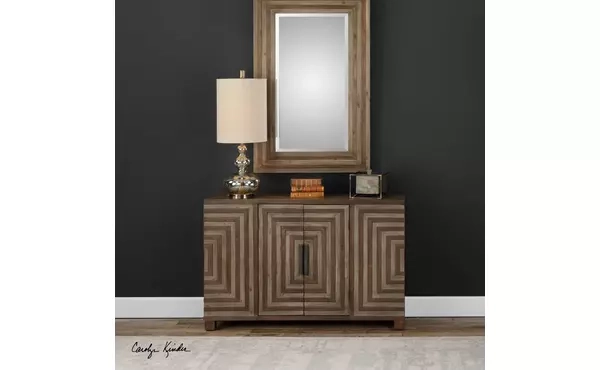
The entryway of a newly renovated urban apartment often presents an immediate spatial puzzle. Blank walls demand visual grounding, narrow structural layouts resist bulky furnishings, and the persistent clutter of daily life requires a home that is both accessible and entirely hidden from view. Stepping into such a space, the eye naturally seeks a focal point—a piece of furniture that anchors the room without overwhelming its square footage. Too often, designers default to generic minimalism or overly ornate antiques that clash with contemporary living. It was precisely this spatial friction that veteran designer Carolyn Kinder sought to resolve when conceptualizing the Layton Console Cabinet for Uttermost.
Instead of treating storage as an afterthought, Kinder approached the credenza as a functional canvas. She recognized that contemporary interiors—while increasingly open-plan and streamlined—frequently suffer from a sterile lack of tactile warmth. Modern homeowners want clean architectural lines, yet they crave organic textures that ground their living spaces. The Layton Console Cabinet bridges this aesthetic chasm through a clever manipulation of geometry, shadow, and tactile surface treatment. It stands as a masterclass in how utility can be fused with high-end artisanal craft, offering a blueprint for modern interior styling that refuses to sacrifice personality for the sake of efficiency.
Analyzing a piece of furniture of this caliber requires looking past the surface glamour of glossy product photography and examining the raw mechanics of its design. From its 48.5-inch width and shallow 12.5-inch depth to its deliberate use of rustic two-toned fir veneer over an engineered MDF core, every physical dimension tells a story of adaptation. Urban spaces are shrinking, yet our appetite for curated, well-traveled style continues to expand. Kinder’s creation speaks directly to this paradox, demonstrating how thoughtful scaling and repeating patterns can alter our perception of volume in tight residential footprints.
The Architecture of Geometry and Mid-Century Influence
The visual signature of the Layton console rests heavily on its striking geometric parquetry pattern. At first glance, the cabinet face draws the eye across a rhythmic sequence of angled wood grains that shift subtly under changing room lighting. Kinder intentionally integrated hints of mid-century modern aesthetic into this repeating layout, modernizing traditional parquetry by emphasizing strong lines over intricate, fussy flourishes. This graphic quality serves a dual purpose in contemporary architecture: it introduces pattern to minimalist rooms without requiring busy wallpaper or heavy textiles, and it creates an optical illusion of depth that breaks up the monotony of flat corridor walls.
Achieving this level of visual impact requires a disciplined approach to wood selection and grain direction. The cabinet utilizes a rustic two-toned fir veneer, a material choice that balances the rigid precision of the geometric layout with organic warmth. Fir brings a distinct grain character that refuses to look uniform or manufactured, ensuring that no two cabinets feel identical. By varying the stain tones across the individual parquetry triangles, Kinder managed to capture light dynamically throughout the day. Morning sun highlights the lighter hues and sharp angles, while evening lamp light deepens the rustic shadows, giving the cabinet an evolving presence within the room.
Beyond mere aesthetics, the structural geometry of the cabinet dictates how it interacts with surrounding furniture silhouettes. In rooms dominated by heavy upholstery, such as overstuffed sectional sofas or chunky club chairs, the sharp, linear discipline of the Layton console introduces a necessary counterpoint. It prevents a living room from feeling visually heavy or top-heavy by offering a crisp, tailored horizon line. This interplay between soft seating and structured case goods is a hallmark of Kinder’s design philosophy, proving that modern living spaces thrive on calculated contrast rather than monotonous matching sets.
Materiality, Durability, and the Practicality of Fir Veneer
When evaluating furniture destined for high-traffic zones like entryways, hallways, or busy living rooms, surface durability is just as critical as visual appeal. The Layton console achieves its resilient structure through a thoughtful pairing of medium-density fiberboard (MDF) and genuine fir veneer. While solid wood purists sometimes dismiss wood veneers, furniture engineers understand that MDF provides a dimensionally stable substrate that resists the warping, cracking, and splitting common in solid softwoods when exposed to fluctuating indoor humidity and seasonal heating cycles.
The application of the rustic two-toned fir veneer over this stable core allows the cabinet to maintain a relatively lightweight profile—tipping the scales at roughly 65 to 77 pounds depending on precise hardware specifications—while retaining a robust feel. This weight distribution makes it manageable to position solo or anchor securely to a wall stud, an essential safety step for narrow consoles prone to tipping. Furthermore, the distressed, relaxed finish applied to the fir acts as a practical shield against everyday wear and tear. Minor scuffs or surface abrasions naturally blend into the rustic grain variations, sparing homeowners the anxiety of maintaining a pristine, high-gloss lacquer finish.
Hardware choices further anchor this material integrity. The cabinet doors and center storage compartments are fitted with old iron bar pulls, providing a tactile, industrial counterweight to the refined wood parquetry. These pulls feature a dark, slightly weathered patina that resists showing fingerprints and visually grounds the base of the unit. The choice of iron introduces a subtle nod to transitional and industrial design vocabularies, proving that a console does not need to belong to a single, rigid design category to feel cohesive within a modern interior ecosystem.
Step-by-Step Methodology for Styling the Layton Console in Your Home
Integrating a statement console like the Layton into an existing floor plan requires a methodical approach to scale, negative space, and functional zoning. Because the cabinet measures roughly 48.5 inches wide by 32 inches high, but features a remarkably slim 12.5-inch depth, it fits effortlessly into tight architectural bottlenecks where standard 20-inch-deep credenzas would block traffic flow.
- Step 1 (Assess Spatial Clearance and Traffic Flow): Measure your intended wall space, ensuring you leave at least 30 to 36 inches of clear walking path in front of the cabinet. Because the Layton is only 12.5 inches deep, it excels in narrow apartment entryways and tight hallways where standard furniture creates dangerous bottlenecks.
- Step 2 (Anchor with Vertical Scale): Balance the low-slung, 32-inch horizontal profile of the console by hanging a vertically oriented mirror or a large-scale piece of abstract art approximately 6 to 8 inches above the top surface. This vertical anchor prevents the furniture from feeling lost against expansive walls and draws the eye upward.
- Step 3 (Curate Asymmetrical Surface Vignettes): Avoid symmetrical clutter by applying the rule of thirds to the top surface. Place a taller architectural element—such as a ceramic lamp or a slender sculptural branch—on one side, and balance it with a low stack of art books and a small catch-all tray for keys on the opposite side, leaving the center geometric pattern partially visible.
- Step 4 (Optimize Hidden Interior Storage): Open the center portion of the cabinet to access the two fixed interior shelves. Utilize this hidden cavity for high-utility items that disrupt visual calm—such as mail sorting bins, extra charging cords, router equipment, or glassware if utilizing the console as a living room mini-bar.
- Step 5 (Secure and Ground the Base): Ensure the cabinet sits flush and level on hard flooring surfaces using adjustable leveling feet if necessary. If small children or pets frequent the space, utilize the included anti-tip hardware brackets to securely anchor the lightweight MDF frame to wall studs for absolute safety.
Navigating Common Placement Pitfalls and Functional Workarounds
Even experienced interior decorators occasionally misjudge the scale and functional demands of narrow console cabinets, leading to awkward layouts or compromised utility. One frequent misstep involves overloading the top surface of the cabinet with too many small decorative objects, which completely obscures the stunning geometric parquetry that makes the Layton unique. When styling a statement piece with an intricate wood grain, the surface should breathe; letting the craftsmanship of the fir veneer remain visible is just as important as the accessories placed upon it.
Another common pitfall is ignoring the functional limitations of fixed interior shelving. Unlike adjustable shelving units that allow for customized vertical spacing, the Layton features two fixed interior shelves within its center cabinet. Homeowners attempting to store oversized liquor bottles, bulky photo albums, or tall electronics often find themselves frustrated by vertical clearance constraints. Practitioners can easily work around this limitation by utilizing shallow storage baskets or modular acrylic trays that slide neatly onto the fixed shelves, organizing smaller items efficiently without requiring vertical flexibility.
Finally, lighting placement often undermines the dramatic potential of textured wood veneers. Placing the console against a dark, unlit corridor wall causes the rustic two-toned finish and old iron pulls to disappear into shadow. Designers solve this by incorporating layered lighting schemes—such as positioning a low-wattage table lamp directly on the surface or installing a warm-toned picture light overhead. This directional illumination rakes across the parquetry triangles, casting soft shadows that highlight the meticulous carpentry and elevate the console from basic storage to a functional art installation.
The Broader Impact of Artisanal Utility on Contemporary Living
The enduring appeal of Carolyn Kinder’s design work lies in its rejection of disposable, mass-market furniture trends in favor of timeless, well-traveled style. As modern living spaces increasingly merge kitchen, dining, and living zones into sprawling open-concept floor plans, furniture must work harder than ever before. A console cabinet is no longer merely a surface for dropping mail or a box for hiding shoes; it acts as a room divider, a structural anchor, and a tactile anchor that warms up cold drywall and steel framing.
This shift reflects a broader consumer desire for authenticity and craftsmanship in the home. People are spending more time in their living spaces and seeking out items that carry visual narratives. The combination of rustic fir veneer, geometric parquetry, and industrial iron hardware tells a story of mixed materials that feels grounded rather than hyper-modern or sterile. By designing pieces like the Layton for manufacturers like Uttermost, Kinder successfully bridges the gap between exclusive trade-only showroom aesthetics and accessible residential design, empowering homeowners to curate sophisticated interiors with genuine character.
Furthermore, the economic and environmental efficiency of utilizing engineered MDF substrates clad in genuine wood veneers represents a sustainable evolution in furniture manufacturing. Conserving slow-growing old-growth hardwoods by utilizing renewable veneer slices over stable core boards allows high-end design to scale responsibly. Homeowners invest in a piece that delivers the rich aesthetic weight of solid timber without contributing excessively to deforestation. This conscious approach to material sourcing ensures that the furniture we select today remains both ethically sound and structurally resilient for decades of daily family life.
Key Takeaways and Strategic Recommendations for Interior Styling
Transforming a blank wall into a sophisticated focal point using the Layton Console Cabinet requires a balanced blend of architectural awareness, restraint, and tactile layering. When planning your layout, keep these foundational principles at the forefront of your design process:
- Embrace Contrast: Pair the geometric, rustic wood patterns of the cabinet with clean solid-colored walls, soft linen upholstery, or minimalist metal accents to let the parquetry stand out as a natural focal point.
- Respect Scale in Tight Spaces: Leverage the slim 12.5-inch depth to activate narrow corridors, tight entryways, or awkward transitional spaces without sacrificing valuable walking clearance.
- Layer Lighting Dynamically: Utilize directional table lamps or overhead picture lighting to cast warm shadows across the two-toned fir veneer, accentuating the depth of the geometric pattern throughout the day.
- Prioritize Functional Organization: Make the most of the two fixed interior shelves by using shallow baskets and trays to keep everyday clutter hidden behind the graphic cabinet doors.
- Anchor and Secure: Always verify wall anchoring, particularly in high-traffic hallways, ensuring your furniture remains completely stable while supporting heavy lamps or decorative art pieces above.
Great interior design ultimately serves a deeply human purpose: creating environments that feel restorative, organized, and unmistakably personal. The Layton Console Cabinet endures as a testament to this philosophy, proving that structural utility and artistic expression are never mutually exclusive. When a piece of furniture is engineered with both spatial constraints and visual storytelling in mind, it ceases to be a passive object taking up floor space and becomes an active participant in daily home life.
As we look toward the future of residential design, the demand for adaptable, multi-functional furnishings will only accelerate. Homes must flex to accommodate remote work, changing family dynamics, and compact urban footprints without ever feeling cramped or chaotic. By investing in statement pieces that respect scale, celebrate organic materials, and honor meticulous craftsmanship, we build living spaces that are ready for whatever life brings through the front door.


